
Review · PRIVATE BANGKOK TOURS
Flower Market & Floral Art: Multilingual Private Tour [EN/others]
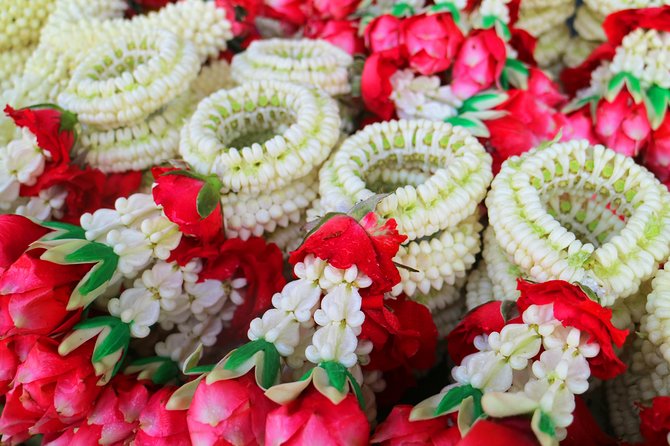
Flowers, temples, and quiet surprises. I like this tour because you get hands-on lotus folding plus a Thai garland workshop, and the day ends in the Baan Kudi Chin Museum with stories you won’t easily find on your own. One drawback: it’s not a good pick if you have walking difficulty, since you’ll move through markets and temple areas.
You can choose a morning or afternoon start, and it runs about four hours. What makes it feel worth it is the private format: your guide keeps the pace realistic, adds context at each stop, and gives you room to ask questions as you go.
Price-wise, it’s $95.17 per person for a private, guided experience that includes the workshops and museum entry. Lunch isn’t included, so you’ll want to plan around that, but you’re paying for time with local artisans—not just sightseeing.
In This Review
- Key things I’d circle before booking
- Starting at Pak Khlong Flower Talat, Bangkok’s big flower market
- Lotus folding: making Bua Luang and Bua Chut with a local vendor
- Kalayanamitr Temple by ferry: fish-feeding merit and the Thai-Chinese blend
- The longest stop: an hour of floral craft with temple artisans
- Guanyin shrine, Santa Cruz Church, and the Kudi Chin community walk
- Inside Baan Kudi Chin Museum: Siam–Portuguese stories in one practical stop
- Duration, transportation, and why the private format feels worth it
- What you’ll get most from this tour (and who it’s not for)
- Should you book Flower Market & Floral Art in Bangkok?
- FAQ
- What’s included in the tour?
- How long is the Flower Market & Floral Art tour?
- Can I choose a morning or afternoon tour time?
- Is the Baan Kudi Chin Museum included, and is it ever closed?
- Where does the tour start and end?
- Is hotel pickup included?
- Does the tour include lunch?
- What languages are available for the guide or interpreter?
- Is this a private tour?
- Is there any limitation for guests with mobility issues?
Key things I’d circle before booking
![Flower Market & Floral Art: Multilingual Private Tour [EN/others] - Key things I’d circle before booking](https://2.bangkoktourreviews.com/wp-content/uploads/flower-market-floral-art-multilingual-private-tour-en-others-1.jpg)
- Pak Khlong Flower Talat: start at Bangkok’s original, largest flower market with lots to see right away
- Thai lotus folding: learn Bua Luang (cone-shaped) and Bua Chut (ball-shaped) to use in an offering moment
- Jasmine garland workshop: make flower offerings with Thai artisans in a temple setting
- Ferry to Kalayanamitr Temple: a quick river ride plus a short merit-making stop at the pier
- Kudi Chin (Siam–Portuguese) neighborhood: visit a shrine and Santa Cruz Church area, then head into the museum
- Real guide attention: the tour is private, and guides like Nina and Nine are described as adjusting the route to the group
Starting at Pak Khlong Flower Talat, Bangkok’s big flower market
![Flower Market & Floral Art: Multilingual Private Tour [EN/others] - Starting at Pak Khlong Flower Talat, Bangkok’s big flower market](https://2.bangkoktourreviews.com/wp-content/uploads/flower-market-floral-art-multilingual-private-tour-en-others-2.jpg)
If you want Bangkok to feel less like a checklist and more like a lived-in place, the best way in is right at Pak Khlong Flower Talat Original. This is the market locals hit early for fresh flowers, and it shows. You’re not just looking at pretty bouquets—you’re seeing where the city’s daily temple offerings begin.
The market stop is about 30 minutes, which is a good length. Long enough to soak up sights and smells, short enough that it doesn’t turn into an endurance test. You’ll also get a sense of the rhythms of the trade: sellers move with purpose, florists scan quality, and the whole place runs on speed and routine.
A practical tip for this kind of market visit: keep your camera ready, but also keep your hands free. You’ll be learning crafts later, and you don’t want to lug extra bags through crowded areas.
Your crew only, your own clock
- Bangkok: Grand Palace, Wat Pho, and Wat Arun Private Tour
★ 4.8 · 855 reviews - Private Excursion to Maeklong Railway and Floating Markets
★ 5.0 · 850 reviews - Floating and Railway Market (Optional Waterfall): Private Tour
★ 5.0 · 827 reviews
Lotus folding: making Bua Luang and Bua Chut with a local vendor
Next, you get a workshop that’s small and focused: lotus folding with a local seller. The tour specifically teaches two styles—Bua Luang (the cone-shaped lotus) and Bua Chut (the ball-shaped lotus). That detail matters because it gives you something concrete to aim for, not just a generic craft class.
You’ll spend about 20 minutes on this hands-on part. This is the sweet spot for most people: enough time to follow the steps, mess up a bit, and still finish with something that looks like an offering.
Then you bring your folded lotuses for a respectful moment at a temple. That’s where the craft stops being just a souvenir activity and becomes part of the experience’s meaning. Even if you don’t speak Thai, you’ll feel the intention in how people use what they made.
What I like here is that it’s not a “watch and leave” setup. It’s active learning with a real craft seller, so you leave knowing how the folds work—and you’ll probably notice details later when you see offerings in other places.
Kalayanamitr Temple by ferry: fish-feeding merit and the Thai-Chinese blend
After the flower and craft stops, you switch gears in a very Bangkok way: a ferry ride to Kalayanamitr Temple. You’ll also get a short stop at the pier to feed fish. In Thai belief, feeding fish is tied to making merit, and it’s a quick cultural moment that doesn’t need a guidebook to understand. You just need to follow what’s offered and behave respectfully near the water.
This portion is brief—about 10 minutes for the pier moment—then you move into the temple. At Wat Kalayanamitr Varamahavihara, you spend around 20 minutes. The temple is described as a smooth blend of Thai and Chinese Buddhist beliefs, which is a helpful way to frame what you’re seeing. Look for the mixture in design and devotional style, not just separate “Thai” and “Chinese” boxes.
You’ll also pay respect to Sam Por Kong, noted as one of the largest golden Buddha images in Bangkok. That’s the kind of landmark that makes a temple visit feel less like wandering and more like having a destination.
Small caution: temple areas can be uneven and you’ll likely be on your feet more than you expect. This tour isn’t ideal for anyone who struggles with mobility, since the schedule packs several short walks into a compact four hours.
The longest stop: an hour of floral craft with temple artisans
![Flower Market & Floral Art: Multilingual Private Tour [EN/others] - The longest stop: an hour of floral craft with temple artisans](https://2.bangkoktourreviews.com/wp-content/uploads/flower-market-floral-art-multilingual-private-tour-en-others-4.jpg)
The most time-intensive part of the tour is the workshop inside the Kalayanamitr Temple area—about one hour. This is where the day becomes genuinely creative rather than just observational.
You’ll learn a Thai floral handicraft workshop with Thai local artisans. The tour also notes a social enterprise element: artisans are hired from the Kudi Khow community, where many residents have limited opportunities. That detail changes the tone. You’re not only buying a ticket to see flowers—you’re supporting a structured way of earning through craft skills.
From a visitor perspective, this hour is the best chance to slow down, ask questions, and get practical help. Even if you’ve never folded anything before, this kind of workshop format usually gives you enough guidance to end with something you can be proud of.
In the reviews you provided, guide Nine is mentioned as well-organized during the garland-making part. Another guide, Nina, is described as adapting to her group’s needs (including extra stops for ice cream and cold drinks). While your exact experience depends on your guide and the day, those details are good signs that guides don’t treat this as a rigid script.
More private runs, just your group





Guanyin shrine, Santa Cruz Church, and the Kudi Chin community walk
![Flower Market & Floral Art: Multilingual Private Tour [EN/others] - Guanyin shrine, Santa Cruz Church, and the Kudi Chin community walk](https://2.bangkoktourreviews.com/wp-content/uploads/flower-market-floral-art-multilingual-private-tour-en-others-5.jpg)
After you’ve worked with flowers and stepped through the devotional space, the tour shifts into community and history. You’ll have a short stop at a Guanyin Shrine, described as being among the oldest shrines in Thailand, traced back to King Taksin’s reign (noted as about 230 years ago). The tour also points out that this Guanyin statue is different from other shrines, which you might notice just by looking for variation in how it’s presented.
This section is about 10 minutes—more of a pause and context stop than a major attraction. Still, it’s useful because it ties together the theme of religious life in this neighborhood.
Then you walk toward Santa Cruz Church (also known as Kudi Chin), near Kalayanamitr Temple. The tour explanation links the church to Portuguese people in Thailand, built after King Taksin granted a portion of land. Even without deep background reading, this is one of those stops that helps Bangkok feel layered, not random.
This neighborhood walk also helps break the schedule into a more human pace. Instead of rushing from one temple entrance to another, you get short intervals where you can look, listen, and absorb.
Inside Baan Kudi Chin Museum: Siam–Portuguese stories in one practical stop
![Flower Market & Floral Art: Multilingual Private Tour [EN/others] - Inside Baan Kudi Chin Museum: Siam–Portuguese stories in one practical stop](https://2.bangkoktourreviews.com/wp-content/uploads/flower-market-floral-art-multilingual-private-tour-en-others-6.jpg)
The final cultural anchor is the Baan Kudi Chin Museum, with admission included. You’ll spend about 20 minutes here—long enough to get the main ideas, not so long that you’ll feel stuck.
The museum is described as a learning place for local culture and history tied to the Siam–Portuguese lineage that still lives in the area. You’ll also have a chance to try Kudi Chin snacks. That matters because food often teaches you what history alone can’t—how daily life and identity show up in flavors.
One important planning note: the museum is closed on Monday. If your dates land on Monday, you’d need to choose a different tour day (or pick another experience for that slot).
I like museum stops that don’t demand a full afternoon. A 20-minute visit works well when paired with hands-on workshops and temple walking—by the time you get there, you’re ready to connect the dots.
Duration, transportation, and why the private format feels worth it
![Flower Market & Floral Art: Multilingual Private Tour [EN/others] - Duration, transportation, and why the private format feels worth it](https://2.bangkoktourreviews.com/wp-content/uploads/flower-market-floral-art-multilingual-private-tour-en-others-7.jpg)
This experience lasts about four hours, which is a big deal in Bangkok. You get a compact route that still covers a market, two temple-related craft moments, a ferry ride, and museum time. That’s a lot for one morning or afternoon.
Transportation is also part of the value. The tour includes a private air-conditioned vehicle for hotel transfer, plus a licensed guide (or interpreter depending on your language choice). You also get a mobile ticket, so you’re not stuck hunting for paperwork.
The “private” part matters beyond comfort. It gives you flexibility—whether that means asking extra questions, taking a moment to catch your breath, or adjusting small route decisions when your group needs it. In the reviews, Nina is specifically mentioned as adapting the tour to her guests’ needs, and Nine is noted for being organized during the floral craft. That’s the kind of care you want on a cultural day where small details can change everything.
One thing to plan: lunch isn’t included. If you book a morning tour, you may want to eat after. If you do an afternoon tour, you may already be hungry, so plan a meal nearby after the museum stop.
What you’ll get most from this tour (and who it’s not for)
![Flower Market & Floral Art: Multilingual Private Tour [EN/others] - What you’ll get most from this tour (and who it’s not for)](https://2.bangkoktourreviews.com/wp-content/uploads/flower-market-floral-art-multilingual-private-tour-en-others-8.jpg)
This is best for you if you want Bangkok to feel personal and hands-on. If you like craft learning, religious culture, or community history, this tour gives you all three in a short window.
It’s also a solid family option. One review mentions daughters ages 9 and 11 enjoying it, which makes sense: crafts are easier for kids than long temple lectures, and the flower market gives nonstop visual interest.
You should think twice if you have mobility limitations. The tour notes it’s not recommended for travelers with walking difficulty, so if stairs, uneven temple surfaces, or sustained standing are an issue for you, look for a different option.
Should you book Flower Market & Floral Art in Bangkok?
Yes, if you want a four-hour day that blends sensory market time with real craft skills and a neighborhood story you can actually remember. The value is strongest when you care about doing the work—lotus folding and floral offering-making—rather than just watching.
I’d skip it only if walking is a problem for you or if you’re not interested in crafts or temple etiquette. Also, check the museum’s Monday closure if your schedule includes that day.
If your idea of a great Bangkok morning is flowers in the air, a ferry ride, and an end stop where you can taste and learn about the local Siam–Portuguese community, this private tour hits that sweet spot.
FAQ
What’s included in the tour?
The tour includes a Thai lotus folding workshop, a Thai garland workshop, admission to Baan Kudi Chin Museum, and access with a licensed guide or interpreter based on the language option you choose.
How long is the Flower Market & Floral Art tour?
It runs about 4 hours.
Can I choose a morning or afternoon tour time?
Yes. You can choose either a morning or an afternoon tour to match your schedule.
Is the Baan Kudi Chin Museum included, and is it ever closed?
Museum admission is included, but it is closed on Monday.
Where does the tour start and end?
The tour starts at Rajini School (444 Thanon Maha Rat, Khwaeng Phra Borom Maha Ratchawang, Khet Phra Nakhon, Krung Thep Maha Nakhon 10200, Thailand) and ends back at the same meeting point.
Is hotel pickup included?
Pickup is offered, and the tour includes a private air-conditioned vehicle for hotel transfer.
Does the tour include lunch?
No. Lunch is not included, and you’ll order and pay for it yourself.
What languages are available for the guide or interpreter?
English is available, plus options listed for ES, IT, DE, FR, and ZH.
Is this a private tour?
Yes. It’s a private tour/activity, and only your group participates.
Is there any limitation for guests with mobility issues?
It’s not recommended for travelers with walking difficulty.
More Tours in Bangkok



More Tour Reviews in Bangkok




Private Days, Just Your Crew

Just In: Fresh Bangkok Reviews






Private Bangkok Tours, compared.
 ★ 5.0Bangkok by Private Guide: Full Day Tour In and AroundFrom $724,323 reviews
 ★ 4.8Grand Palace, Wat Pho, and Wat Arun Private TourFrom $143855 reviews
 ★ 5.0Private Excursion to Maeklong Railway and Floating MarketsFrom $130850 reviews
 ★ 5.0Floating and Railway Market (Optional Waterfall): Private TourFrom $127827 reviews
 ★ 4.7Full-Day Customized Tour with Local TransportationFrom $93696 reviews
 ★ 4.5Customize Your Own Private Bangkok City TourFrom $72588 reviews
 ★ 5.0Private Tour: Best of Bangkok in A DayFrom $227515 reviews
 ★ 5.0Private Excursion to Floating Market and Ayutthaya World HeritageFrom $184515 reviews
Browse the lists this tour appears in